Guide 2 of 3
Stalls and spins: why RC planes stall and how to recover
A stall is not the motor stopping. It is the wing losing its grip on the air, and it happens at an angle, not at a speed. Understand that, and most stalls never happen.
What a stall is
The angle of attack is the angle between the wing and the air flowing at it. As it grows, the wing makes more lift, up to a limit called the critical angle. Past that angle the air can no longer follow the curve of the wing's top surface. It breaks away, the lift falls and the drag climbs. That is a stall.
The FAA's Airplane Flying Handbook (FAA-H-8083-3C, ch. 5) puts it plainly: a stall is the result of exceeding the critical angle of attack, "not of insufficient airspeed", and it is "possible to stall the wing at any airspeed, at any flight attitude, and at any power setting".
The stall speed is simply the slowest speed at which the wing can hold the plane up in level flight before it reaches that angle. A heavier plane, or a smaller wing, has a higher one. In Openflight's flight model, a large high wing trainer stalls in level flight at about 7.2 m/s (26 km/h).
Why RC planes stall
Nose up and too slow
The classic beginner stall is a climb too steep just after takeoff, or a landing approach stretched by pulling back instead of adding power. Pulling back raises the angle of attack and bleeds off speed, so the plane needs a steeper angle still, until the wing gives up.
Turning raises the stall speed
In a level turn the wing has to hold up the plane and pull it around the turn as well, so it carries more than the plane's weight. That extra load is the load factor, and the stall speed grows with its square root. The handbook's example: in a level 60 degree banked turn the load factor is 2, and the plane "will stall at a speed that is 41 percent higher" than in level flight (ch. 5).
| Bank in a level turn | Load factor | Stall speed rises by | The 7.2 m/s trainer stalls at |
|---|---|---|---|
| 30 degrees | 1.15 | 7 percent | 7.7 m/s |
| 45 degrees | 1.41 | 19 percent | 8.6 m/s |
| 60 degrees | 2 | 41 percent | 10.2 m/s |
The low, slow turn onto final
Put those together and you have the most common stall in RC: the turn from base leg onto final approach, low, slow and with the throttle back. Seeing the plane overshoot the strip, the pilot tightens the turn with elevator, which raises the angle of attack, or pushes the nose round with rudder. In that skid the inside wing is slower, stalls first and rolls the plane into the turn, with no height left to recover. The handbook warns that a stall in a slipping or skidding turn "can result in a spin entry" (ch. 5). If the turn onto final is going wide, let it go wide, or go around.
The downwind turn
In a steady wind a plane's airspeed does not change when it turns downwind; only its speed over the ground does. Openflight's flight model shows the same: into a 5 m/s headwind a trainer flies exactly the airspeed it flies in still air, and 5 m/s slower over the ground. The danger is what the pilot does next. Downwind the plane looks fast, so the pilot closes the throttle or pulls back to slow it, and stalls it. Fly by attitude and power, not by how fast the plane crosses the ground.
A hard pull at speed
Yank full up elevator from fast flight and the wing can pass its critical angle long before the plane slows down. The handbook calls any stall above 1 g an accelerated stall, and names the overshooting turn from base to final as one of the places it most often happens (ch. 5). It comes at a speed where you would not expect a stall at all, and it can drop a wing.
How to recognise a stall
A full size pilot feels a stall coming. You are standing on the ground, so you have to see it:
- The controls go soft and the plane answers them slowly.
- It needs more and more up elevator to hold its height.
- The nose is high but the plane is sinking.
- The nose drops on its own, even with the stick held back, or a wing drops.
For a power off stall the handbook names the stick itself as the main cue: "the elevator control position (full up elevator against the stops) and a high descent rate" (ch. 5). If your thumb is at the back of its travel and the plane is still coming down, it is stalled.
Planes stall in different ways. In Openflight's flight model, whose stalls are built from measured wind tunnel data for each wing's section class (the UIUC Summary of Low-Speed Airfoil Data), a high wing trainer held at full up with the throttle closed mostly mushes: the nose drops a few degrees and it sinks with its wings nearly level. Other wings drop a wing instead, for the reasons under tip stalls below.
How to recover from a stall
The handbook's stall recovery, adapted for an RC plane (ch. 5):
- Lower the nose. Ease the elevator forward until the plane is flying again: the controls firm up and the sink stops. This is the step that matters. The handbook stresses that pilots who put power or holding height first, before lowering the angle of attack, lose control.
- Level the wings with the aileron, and use the rudder to stop any yaw, so the stall does not become a spin.
- Add power smoothly. Power reduces the height you lose, but it does not end a stall by itself.
- Ease back to level flight. Pull out gently. A hard pull straight away stalls the wing again, the handbook's secondary stall.
Do not try to pick up a dropped wing with aileron while the wing is still stalled. The aileron on the low wing goes down, which raises that wing's angle of attack and can stall it further, so it drops more. Lower the nose first, then level the wings (ch. 5).
Every recovery costs height. That is why you practise stalls high, and why the low turn onto final is so unforgiving.
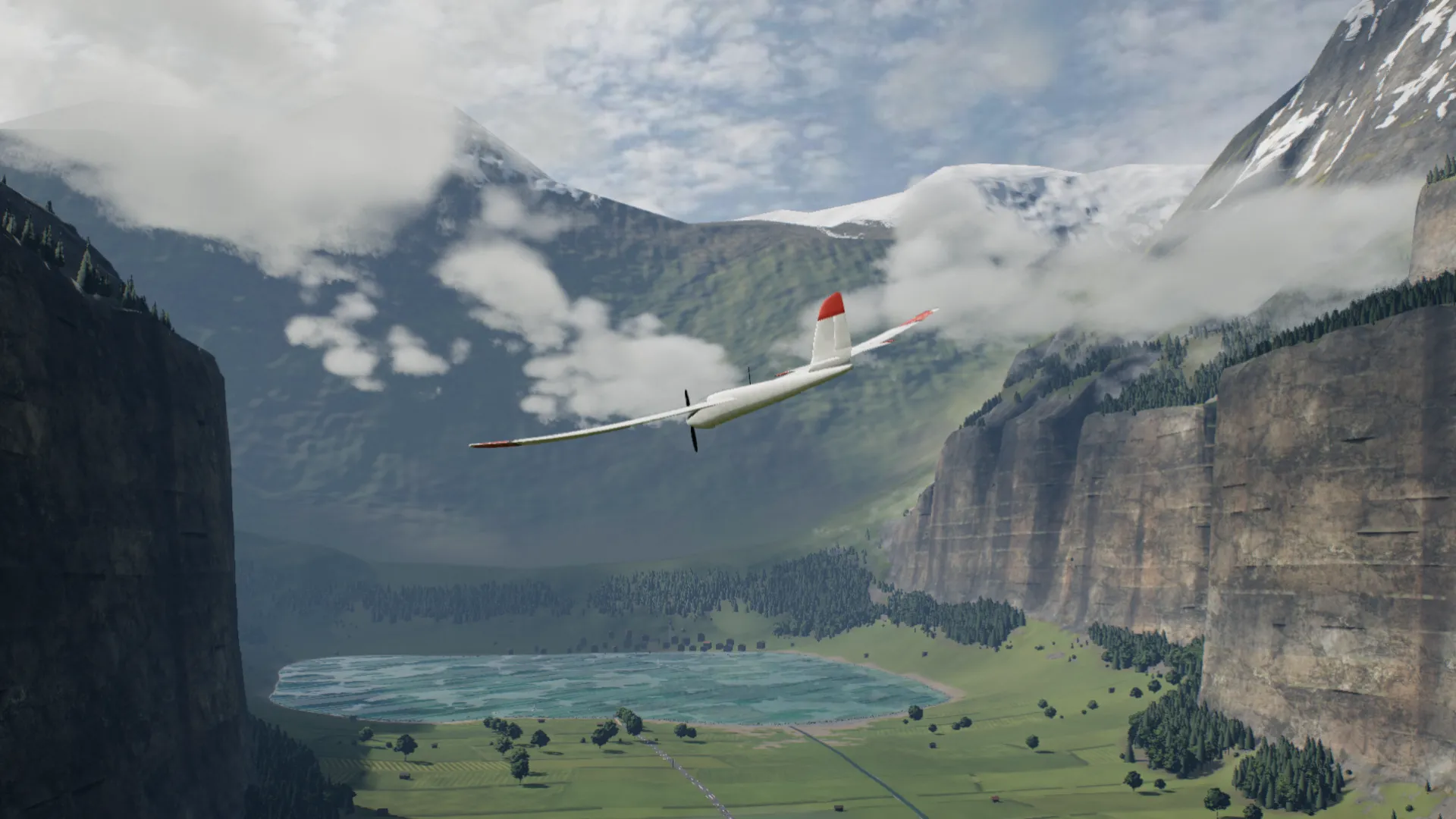
Tip stalls
A wing does not stall all at once. Where it stalls first depends on its shape. A rectangular wing carries the most lift near the root, so its root stalls first. Openflight's flight model shares a wing's lift along its span by the method of NACA TM 948, and on a rectangular wing that puts the tips' stall well after the root's. Meanwhile the ailerons, out at the tips, keep working.
A tapered or swept wing carries more of its lift further out, so its tip can stall first. One tip stops lifting before the other, and the plane rolls sharply toward it: a tip stall. Designers fight this with washout, a twist that sets the tips at a smaller angle than the root, so the root stalls first. Most full size training aircraft are built to stall from the root outward (ch. 5).
A tip stall low on the approach is one of the commonest ways to break a plane. Keep a little extra speed on final, keep the turns gentle near the ground, and if a wing drops at low speed, the cure is still the elevator forward first.
Spins
A spin is a stall with yaw. The handbook: a spin happens when "at least one of the airplane's wings" passes the critical angle "with a sideslip or yaw acting on the airplane" (ch. 5). The wing going down meets the air at a steeper angle, so it is more deeply stalled and lifts less. The wing going up lifts more. The difference keeps the plane rolling and yawing: autorotation. The plane corkscrews down, nose low, at a low and steady airspeed, and it spins in the direction of the rudder.
Spin recovery
The handbook's six steps, for when the plane's own manual gives none (ch. 5):
- Throttle to idle. Power can flatten a spin, and usually speeds up its rotation.
- Ailerons neutral. Aileron either way can make the spin worse.
- Full opposite rudder, briskly, held until the rotation stops.
- Elevator forward of neutral, straight after the rudder. Do not wait for the rotation to stop.
- Rudder to neutral as soon as the rotation stops.
- Pull out of the dive gently, or you can stall again and spin again.
If your plane's manual gives its own spin recovery, follow the manual. The handbook says the same of full size aircraft.
Practise it on purpose
- Climb high, upwind of you, with the wings level.
- Close the throttle and slowly raise the nose to hold your height. Watch the plane slow down.
- Keep raising it until the stall: the nose drops or a wing goes. Recover with the four steps above.
- Repeat with some power on, then from a gentle turn, as the handbook trains full size pilots (ch. 5).
Do it until the recovery is a reflex, so your thumb moves the elevator forward before you have time to think.
Practise this in Openflight
Openflight is a free RC plane simulator that runs in your browser. Every airframe's stall is built from measured wing section data, so each airframe stalls in its own way: a high wing trainer mushes, and on airframes that spin, full rudder at the stall starts one you recover with the steps above. Stall it a hundred times, high, for free. Openflight is coming soon.
About OpenflightNext guide: How to land an RC plane. Before this one: your first flight. All guides: Learn to fly RC planes.
Sources
- FAA, Airplane Flying Handbook (FAA-H-8083-3C), ch. 5: stalls, load factor, stall recovery, spins and spin recovery. Quotations are from that chapter.
- UIUC, Summary of Low-Speed Airfoil Data, vols. 1 to 3: the measured lift curves past the stall that Openflight's stalls are built on.
- NACA TM 948: the approximation Openflight uses to share a wing's lift along its span.
- Openflight's flight model documentation and tests: the trainer's stall speed, derived and held by the simulator's tests; its stall behaviour, the stall along a rectangular wing and the wind model, measured in the simulator.